
Hazmat Safety Training
Working with hazardous materials in transportation requires more than knowing which label belongs on a package or how to complete a shipping paper. Employees must also understand the hazards they may encounter, know how to protect themselves and recognize what to do when something goes wrong. This is why Hazmat Safety Training is an essential component of the U.S. Department of Transportation’s hazardous materials training requirements.
Under 49 CFR §172.704(a)(3), hazmat employees must receive safety training appropriate to the risks associated with their work. This requirement forms part of the broader training framework contained in 49 CFR Part 172, Subpart H.
Safety training should not be confused with general workplace safety training or with general awareness hazmat training. Its purpose is specifically connected to hazardous materials transportation activities and the potential exposure of hazmat employees to those materials.
For companies involved in manufacturing, chemical distribution, warehousing, freight forwarding, packaging or transportation, understanding this distinction is important when building a compliant hazmat training program.
What Is Hazmat Safety Training Under 49 CFR?
The Hazardous Materials Regulations require safety training to address three principal areas: emergency response information, measures designed to protect employees from the hazards associated with hazardous materials, and methods and procedures for avoiding accidents.
These requirements make hazmat safety training highly practical.
Employees should not only recognize that a material is flammable, corrosive or toxic. They should understand what that hazard means in relation to their work and what measures the employer has implemented to protect them.
A warehouse employee handling drums of corrosive liquid, for example, may require knowledge of different protective measures from an employee loading packages containing flammable liquids. Similarly, someone handling compressed gases can encounter hazards that differ significantly from those associated with environmentally hazardous substances or lithium batteries.
The safety training should therefore reflect the materials, processes and exposure scenarios relevant to the employee.
Emergency Response Information
An important component of hazmat safety training concerns emergency response.
Hazmat employees should understand how to respond when an incident occurs and where appropriate emergency information can be found.
A leaking drum, damaged package or release during loading should never be treated as an ordinary warehouse problem. Hazardous materials can introduce fire, explosion, toxicity, corrosivity and other risks that require specific precautions.
Employees need to know what actions they are expected to take, whom they should notify and when they should withdraw from an unsafe area rather than attempt to control an incident themselves.
Emergency response information required under the HMR can accompany hazardous materials shipments in different forms. The essential point for employees is that appropriate information must be accessible and that they understand how it relates to the material involved.
Training should connect this regulatory requirement with the company’s actual emergency procedures.
Protecting Employees From Exposure
Hazmat safety training must also address measures designed to protect employees from the hazards to which they may be exposed.
This is where training becomes closely connected to workplace reality.
Consider an employee handling a damaged package containing a corrosive liquid. Recognizing the Class 8 hazard label is useful, but recognition alone does not protect the employee. The person also needs to understand the relevant exposure risks and the protective measures established by the employer.
Depending on the operation, those measures can include appropriate personal protective equipment, safe handling procedures, engineering controls, spill-management procedures and restrictions concerning who may enter an affected area.
Personal protective equipment may include chemical-resistant gloves, protective clothing, eye or face protection and other equipment appropriate to the hazards involved.
Training should make clear that PPE is not interchangeable between every hazardous material and every operation. Selection must reflect the actual exposure hazard and the employer’s workplace risk controls.
Preventing Hazmat Accidents
Preventing incidents is another central purpose of safety training.
Many hazardous materials transportation incidents do not begin with a dramatic failure. They can start with something relatively simple: a damaged package that is ignored, a drum moved incorrectly, incompatible products placed together, an unsecured load or a container dropped during handling.
Employees who understand the hazards are better positioned to recognize these situations before they develop into incidents.
Safe handling practices should therefore be connected to routine operations.
Warehouse and loading personnel should know that packages must be inspected for visible damage and should understand why packages must be handled in ways that maintain their integrity. Employees should also recognize circumstances that require work to stop and the package or shipment to be referred to a knowledgeable person.
Accident prevention is not simply about telling employees to “be careful.” Effective training explains the hazards, the control measures and the reasons behind the required procedures.
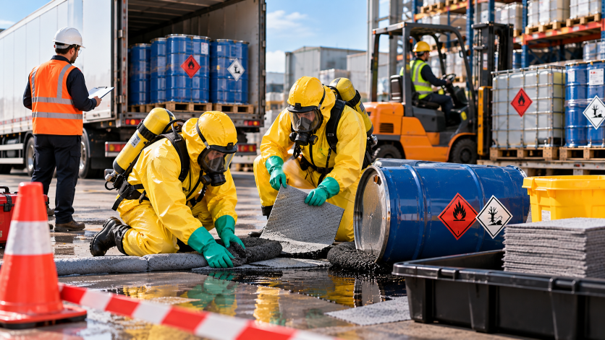
Loading and Unloading Hazardous Materials
Loading and unloading operations deserve particular attention because packages are being moved, positioned and sometimes exposed to mechanical impacts.
Employees may work around forklifts, pallet trucks, loading docks and vehicles while simultaneously handling regulated materials.
A forklift collision with a drum or Intermediate Bulk Container can create consequences far beyond ordinary product damage. Depending on the material involved, a release can produce a fire, toxic exposure, corrosive contamination or environmental damage.
Safety training should therefore reinforce appropriate material-handling procedures, package inspection and the importance of keeping transportation packages in a condition suitable for safe shipment.
Employees also need to understand that visibly leaking or seriously damaged hazardous materials packages cannot simply continue through the normal shipping process.
Hazard Communication Supports Safe Working
Hazmat safety depends heavily on employees being able to recognize what they are dealing with.
Hazard labels, package markings, UN or NA identification numbers, shipping descriptions and placards form part of the HMR hazard communication system.
General awareness training introduces employees to these elements, while safety training connects hazard recognition with protective action.
For example, recognizing a flammable-liquid label should immediately communicate that ignition sources may present a serious hazard. Recognizing a corrosive hazard should prompt awareness of skin and eye exposure risks. Toxic-material markings and labels require another level of caution.
Employees should therefore understand that hazmat markings and labels are not administrative decorations. They communicate information needed to make safe decisions throughout the transportation chain.
Hazmat Safety Training Is Only One Training Component
A common compliance mistake is assuming that a course called “hazmat safety training” automatically covers every DOT training obligation.
Under §172.704, hazmat employees generally need several types of training.
These include general awareness/familiarization training, function-specific training, safety training and security awareness training. Employees with responsibilities under a required security plan must also receive in-depth security training appropriate to those responsibilities.
The components complement each other.
General awareness helps an employee recognize hazardous materials and understand the regulatory framework. Function-specific training teaches the employee how to perform regulated tasks correctly. Safety training focuses on emergency information, self-protection and accident prevention, while security training addresses transportation security risks.
A complete training program brings these elements together.
Who Needs Hazmat Safety Training?
The requirement applies to hazmat employees as defined by the HMR.
This can include employees who classify hazardous materials, select or prepare packaging, mark or label packages, prepare shipping papers, load or unload hazardous materials, operate vehicles transporting hazmat or otherwise perform functions that directly affect hazardous materials transportation safety.
The employee does not necessarily need to work in a chemical plant.
Hazmat employees can be found in manufacturing companies, distribution centers, warehouses, laboratories, freight-forwarding operations, automotive businesses, logistics companies and many other organizations.
Employers should therefore identify employees based on their functions rather than their job titles.
Initial and Recurrent Safety Training
Hazmat employees must complete the required training within 90 days after employment or a change in job function.
Until the required training has been completed, the employee may perform the relevant hazmat functions only under the direct supervision of a properly trained and knowledgeable hazmat employee.
Recurrent hazmat training is required at least once every three years.
Employers must also train and test employees, certify that training and maintain the required records. Training should therefore be managed as a documented compliance process rather than an informal safety briefing.
Online Hazmat Safety Training
Online training can play an important role in building hazardous materials knowledge, particularly for organizations operating multiple warehouses or locations.
The US DOT Hazmat Training (49 CFR) available from Hazmat-Course.com provides online training covering important aspects of the U.S. Hazardous Materials Regulations. The course addresses hazard classification, the Hazardous Materials Table, UN/NA identification numbers, Proper Shipping Names, packaging, marking and labeling, Limited Quantities, placarding, shipping papers, safe handling and loading, PPE, emergency response, incident reporting and security awareness.
This makes the course relevant to personnel involved in preparing, handling, loading or offering hazardous materials for transportation in the United States.
The course provides a broad regulatory and safety foundation. Employers must still evaluate the employee’s actual duties and workplace hazards to determine whether additional function-specific or workplace-specific instruction is required.
Turning Hazmat Knowledge Into Safe Behavior
The ultimate purpose of hazmat safety training is not simply to produce a certificate.
Employees need to recognize hazardous situations before they develop into incidents. They should understand why a damaged package matters, why the correct PPE is important, why ignition sources must be controlled around flammable materials and why emergency procedures must be followed rather than improvised.
That requires training that connects the Hazardous Materials Regulations with real operations.
When general awareness, function-specific knowledge and practical safety training are combined, employees gain a clearer understanding of both what the regulations require and why those requirements matter.
For hazmat employers, that combination supports compliance with 49 CFR while also helping reduce releases, exposures, loading incidents and transportation accidents.
Hazmat safety training is therefore more than one box within §172.704. It is the part of the training system that turns regulatory knowledge into safer decisions when employees are working directly with hazardous materials.
